Thanks for visiting the CutBank Reviews blog! However, we've now moved all things CutBank to one location:
www.cutbankonline.org
In addition to book reviews, you will also find news updates, featured writing, and info regarding contests, submission guidelines, and subscriptions.
Saturday, February 26, 2011
Thursday, February 03, 2011
The Sore Throat and Other Poems by Aaron Kunin

Fence Books, 2010
Review by G.R.O.A.N.
A pleasure of1
Insufficient funds2
Of voices demanding simple3
Formal rei[g]ns, ragged4
This manifold failure5
Of shame to be other than6
Writing about writing about talking about us7
---
1
The Sore Throat wheezes most consistently with the pleasure of textual desperation, a gymnastics of the imprisoned
tongue, presenting a confined space tinged with the hot breath of a damaged throat (the core of which is an unrelenting
mundanity; not diseased, not flayed, but erupting from a common, vaguely unpleasant infection, a minor malady, a
sickness unto dearth). This book is a delight in the way that watching a drunken, curbside woman weeping into her
handbag is a delight. It is a recess suddenly revealed, a raw complex of simple inabilities. It should not be a delight,
but it is—the pathos is almost insulting in that it cuts both ear and tongue, speaker and receiver. The result is deep
intimation between the slightly wounded.
2
What we have is a lack attended by a lot of questions. Buy this book, but buy it with something other than money.
Currency, like articulated desire, is empty gesture: it supposedly holds weight in other realms of experience, but in
Kunin’s shame-based economy, the money, in any amount, is never enough to offer the individual the security it
desires. God is no less a gesture, nor is love. Thought is perhaps the most interrogated realm, the most able to be
communicated and therefore the most able to fail under these heightened expectations. Distinction between mind,
thought, or body is an unnecessary contortion. Not even nothing is unauthorized.
3
Kunin situates the first section of the text as a (revised) translation of Ezra Pound’s “Hugh Selwyn Mauberley”. This
textual situation, of initiating translation within a language (implying that the gulf between poets, especially poets of
distinct generations, is as wide as the gulf between different languages), is considerable. The concentration of potential
renditions into a “severely limited vocabulary” is one way to approach a severely widespread epidemic of shame in a
culture dedicated to openness, one that hides shame behind the façade of rights regarding various forms of protected
speech. Speech, when it fails, essentially needs protection, but this protection is what keeps it from escaping mediation.
Speaking commonly, each individual’s vocabulary is generally limited in much the same way as Kunin’s formal
process, an insight that drains language of the stable bridges that it conjures in its most rudimentary bindings. The
notion of the revised translation (many of the poems of The Sore Throat’s first section appeared as early as 2004 in an
online-only release entitled “The Mauberley Series” through UbuWeb) also implies that translation is conceived of as
realistically more a process than a product, more a paroxysm than a pantomime.
4
This is a very different book from Kunin’s earlier work, Folding Ruler Star, in
which poems were syllabilistically
incised, throttled and restrained from venturing beyond a codified length of expression. The Sore Throat, instead,
crawls exhaustedly into an ever-opening horizon of unsettingly simple diction, into forms that ensnare contradiction, let
it flail and later release it to the soft lap of whitespace; the most bland of landscapes is the most frightening.
5
6
Pervasive entanglements, finally resulting in a parody of the self. The preface to this work ("Note on Method")
inspires a blurred narrative presence: Kunin, in this work and in other interviews, openly writes/speaks about the
experience of notating the external world’s language-din through the physical tic of his “binary hand-alphabet”.
However, this is not a simple notation, the hand acting as a dictaphone, but a creative gray-space in which the operative
device of the writer receives, generates and assembles experience. In other words, the alphabet turns in upon itself,
recording the individual twitch of the hand that records the outer world. Snatches of conversation become snatches of
the self; din becomes him, multiplied. The experience of the world and the experience of the hand experiencing the
world is a process invoking translation, a space where language meets gap and bridge and yet, must fall.
7
Or, this should read “Writing unsuccessfully about successful writing about the failure of talk between ourselves.”
Kunin’s work discriminates the voice above all other noise; poems are wrenched, simply, from a throat garotted by
its own instability. But the book is finally more than this, its parts. It is a stable nation of formal divergence, machines
making brittle music to glitch to, a hand confidently failing to denote the entire quiver of the throat-string, a voice
falling upon other voices to insinuate a pile of imploded harmonics, and tables of whitespace indicating an ordering of
absences. If a thing is worth reading, The Sore Throat and other poems is worth reading.
---
 Aaron Kunin grew up in Minneapolis, was educated at Brown, Johns Hopkins, and Duke. His work has appeared in Boston Review, Fence, The Germ, No: A Journal of The Arts, The Poetry Project Newsletter, The Poker, and elsewhere.
---
G.R.O.A.N. is a collaborative-action imprint currently based in the
Netherlands. They can be contacted at: groanpoetics@gmail.com.

Monday, January 17, 2011
If Not Metamorphic by Brenda Iijima
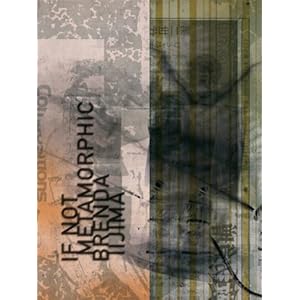
Ahsahta Press, 2010
Reviewed by Christopher Kondrich
In the collection of essays she recently edited )((eco(lang)(uage(reader)), Brenda Iijima writes, “Poetry can actively engage blind spots – where conditioning, denaturalization, and denial for instance, have buttressed the status quo, politically, socially, spiritually, and environmentally, leading to a degrading ecosystem that places terrestrial wellbeing, everyone’s wellbeing, all living organisms, oceans, forests, etc., in jeopardy.” In her new collection of poetry If Not Metamorphic, Iijima addresses our ecological predicament by using language “as a means to create and articulate alternative strategies for living.” Both )((eco(lang)(uage(reader)) and If Not Metamorphic were published this year, and seem to be companion pieces. If Not Metamorphic represents the actualization of the philosophical and linguistic imperatives put forth in her essay in )((eco(lang)(uage(reader)), and largely succeeds in articulating an alternative strategy for living that is jarring, terrifying and somewhat sublime.
The state of ecopoetics as presented in )((eco(lang)(uage(reader)) is one that is complicated by a troubled relationship with the ‘I’. In her essay “Eco-Noise and the Flux of Lux” contained in )((eco(lang)(uage(reader)), Evelyn Reilly captures the concerns of the ecologically aware as being “a matter of finding formal strategies that effect a larger paradigm shift and that actually participate in the task of abolishing the aesthetic use of nature as mirror for human narcissism.” I believe Iijima would agree. In “Tertium Organum,” the third of four poems in If Not Metamorphic, Iijima writes, “I has been extricated from / gesture, endures as a symptom,” but of what? Of language? Of the human projection of self onto nature through language? In Nature, Emerson asks, “have mountains, and waves, and skies, no significance but what we consciously give them when we employ them as emblems of our thoughts?” This is an issue Iijima addresses in “Tertium Organum” with a “message of self-erasure / read theoretically.” If Not Metamorphic is an attempt to erase the self through the violence inherent in language, through the violence language inflicts upon that which it describes.
Language assigns, conditions and codifies. The brain can only narrow its “winnowing screed,” as Iijima writes in “Tertium Organum.” Throughout If Not Metamorphic are signposts of contemporary life; each page contains several words that refer, redirect and re-contextualize the images, ideas, feelings that contain them. The phrase “composted lexicon” appears near the close of the magnificent poem “Time Unions” and one cannot help but apply the purpose and performance of a compost pile to the language of If Not Metamorphic itself. Language that has been left to decompose and develop bacteria is now being used in different ways, for different purposes. Words and phrases that have no cultural reference have been broken down with those signposts of contemporary life to create the “skeletal nomenclature,” as she writes in “Tertium Organum,” of a whole new entity. Cultural signposts such as “industry,” “tear gas,” and “sanctions” are complicated by context, and tempered by tone. Iijima removes a historical legend from the compost pile as “don’t tread on (me) / do not” and doubles-down on her self-erasure. At the end of the poem, she writes a litany of pictures, of differing images:
pictures of rivers
pictures of rivers
pictures of spinal columns
picturing the body, picturing dog
optical illusions have pictures
the autonomy of one owl is a picture
upside down picture
whereas mirror animation picture
when in fact picture picture
pictures picture
picturing pictures solidified
it’d felt as if I answered
Just as mountains are emblems of thought for Emerson, for Iijima pictures are what we make images and objects into with a kind of violation. She tries to break the system down by resisting language, letting language resist itself. When she writes, “it’d felt as if I answered” it is a lost-for-words moment in an attempt to lose one’s words, one’s language and self. Losing one’s words is what we may need to embrace what we violate by describing, equating and aligning with the cultural detritus we use those same words to discuss. Losing one’s words is what may be needed to let mountains be mountains.
And yet Iijima allows her poems to have moments of awe and discovery. Often the discovery is what language has turned itself into, but there is a passage in “Tertium Organum” that nears the sublime:
Numerous numerous worms play with
pulp rose thorns mulch
then I shovel deeper
uncover rocks
The circulatory systems of trees lay here
Bamboo pleasure
showing groin
as sexy as elbow
Even though the “I” appears, this is a moment that is not marred or denigrated by the “I” and its actions, by the referentiality or intentionality of language. Shoveling deeper into the earth is an act of connection that renders the “I” irrelevant. If Not Metamorphic is full of these moments – perhaps not as explicit, perhaps only theoretically – moments that do not so much solve the problems of “I” in an “I”-consumed world, as reroute the mind around the “I.” If Not Metamorphic attempts to tread new pathways between sign and signified, between “I” and nature, in such a way that composts those descriptors, those categories of a violent mind into something new, something useful.
---

Brenda Iijima is from North Adams, Massachusetts and studied at Skidmore College. In addition to writing, Iijima also paints, runs Portable Press, and teaches poetry at Cooper Union. Other recent works include a collection of essays edited by Iijima, )((eco(lang)(uage(reader)), and a collection of poetry, Revv. You'll--ution.
---
Christopher Kondrich is a PhD candidate at the University of Denver. Selections from his book-length poem Canto Fermo have or will appear in Boston Review, Free Verse, Meridian, Notre Dame Review and The Journal.
Thursday, December 16, 2010
Slaves to do These Things, Amy King

BlazeVOX, 2009
http://www.blazevox.org/
Review by Marthe Reed
Moving deftly between registers of the fabulous and the mundane, Amy King’s Slaves To Do These Things articulates a language of resistance and becoming, this transformation figured through the re-configured body: “I thrum between / postures I heal from / and postures you pose in.” Opening with Baudelaire’s description of beauty as “a dream of stone…mute and noble as matter itself” juxtaposed against the dilemma of the embodied soul, being in the world – “I came out twice / sobered and married, / then aimless and pregnant,” King sets her new collection amid the daily rites of Brooklyn —cool weather, poets walking its sidewalks, friends gathering over wine and a meal — even as she warns us, “I am the final / seminary soul to / check your shape / in the dress of that embalming line.” Against the “neglect of a virginal / mother,” a church whose “fear of eternal flames…render[s] the spirit deaf”, she offers an alternative schema of sacred/spirit/body: “this space is blank, though / not intentionally so. It is so / because you are not yet in it.” King describes a dream about-to-manifest amid the catastrophe of political and economic collapse: “we play life / until delivered…everywhere terrorists, suicide failures, half-rolled against the fence of a homeless drifter.” Taking us on a “vision quest” at the Hudson’s edge, she speaks at “a door which opens…to no knock.” Chronicle of the coming of age – or vision – of a poet, the five “acts” of this collection meditate on gender, identity, and nation, “slaves / we made but no / longer cohabit with.”
A simultaneous awakening into poetry and politics, the speaker of these poems wrestles, in angry love poems, with an America of “snake oil’s morning” which she “want[s] to rescue from this toy chest /…[but] won’t use [her] only gusto.” The poet’s dream-formed Brooklyn becomes the scene of encounter with the lost self/Other, in which the divine functions as the site of threat rather than redemption – Claude Cahun’s epigram to “Act III” a confirmation, “Selling one’s soul to God : is to betray the Other.” Rejecting “the tear-soaked armpit / we call God’s love” as “a sideways path / that keeps us safe and criminal,” King’s speaker sends forth from Brooklyn, “me, / lost weed, skulled tulip, with scalloped eye. / A view to escape within.” Of the longing for redemption, only the fear of it “beautiful,” King reminds us that “To believe / a scarecrow’s resurrection, // you must, at first, behold the thing / alive.” Hope, redemption, divine intervention figure as “disease”, perils leaving us begging from “Doctor Starch” and his endless catalog of absurd prescriptions:
& you should, pounds told, eat more,
kill pill, stretch on, walk dogs,
little tongue, stone’s throw, vomit up,
grow heart, asks legs, quiver gut,
shake down, no meat, sex less,
prove life, launch death, sell self,
machine me, x ray, honey mound,
pubic eyes, smoke pipe, victim beef,
star lips, blanket I, apple chunk,
tea bag, growl pouch, pound out,
Turning elseward, King’s speaker “let[s] [her] body grow down / among weeds of singing children”, her mind “portable….[traveling] / the verse and valleys of whole people”, baking them into “shapes and a spoon- / shaped cake to taste the world with.” She leads us with her, outward into other worlds, the ones we’ve overlooked or “never stepped into” because in America “We hold on to the value / of a vote, a soliloquy, a sword.” Even so, we’re no closer to the sought-after redemption, “the lights after the curtain”— we’re still “hoping for a kinder, gentler world.” Riding along with King, we’re the “audience not quite tied / to the running board / of a hazmat jalopy,” “this sprayed-on dream…of supply & demand.” The “God” we’ve been waiting for? She’s re-gendered, “her mocha acetate / A-line” belying “her swollen version/ of [our] abdomen”, pregnant and promising what? Re-embodied she’s growing a “second fetal skin”, “an intimate book” we’re reading, our “forever / project of waking up.”
A bardic vision of the poet, seized from the midst of quotidian Brooklyn, like Whitman before her, reborn tracking the "American" catastrophe, envisioning another birth/re-birth -- a new 'earth'/body/dream born of the "etched-over dream": "we swell and precede / lit to the age of the coming America." A collection in five "acts", both re-creation and performance in which we are the actors, "looking down the hill," tumbling on "the pen's own angle." These poems, "prodigious...as the green pearl in silt," flash in and out of vision's surreal space, into and against love, out of masks, and into the open of the American dream, the American city: "Brooklyn...busy in / its torments, its gashes, its faint array / of willing and rebellious tenants." In "our love", "this art", “the child”, the possibilities of redemption are translated as body, a stage upon which the self performs and re-performs its own becoming: “This crawl space narrows / as the child emerges, // Ever more fractal, / ever more motion.” Slaves, stuck in “the soup of stupidity [passed] off as love’s castigations,” we stand, vertiginous, at the cusp of liberation—“a literal exchange / we reach across.”
---

Amy King is the author of I’m the Man Who Loves You and Antidotes for an Alibi, both from Blazevox Books, The People Instruments (Pavement Saw Press), Kiss Me With the Mouth of Your Country (Dusie Press), and most recently, Slaves to Do These Things (Blazevox). Forthcoming is I Want to Make You Safe (Litmus Press).
Amy organizes “The Count” and interviews for VIDA: Woman in Literary Arts, edits the Poetics List, sponsored by The Electronic Poetry Center (SUNY-Buffalo/University of Pennsylvania), moderates the Women’s Poetry Listserv (WOMPO) and the Goodreads Poetry! Group, and teaches English and Creative Writing at SUNY Nassau Community College. Her poems have been nominated for several Pushcart Prizes, and she has been the recipient of a MacArthur Scholarship for Poetry. Amy King was also the 2007 Poet Laureate of the Blogosphere.
---
Marthe Reed has reviews in New Pages and at Dialogue's End; another is forthcoming from Ekleksographia. She has published two books, Gaze (Black Radish Books) and Tender Box, A Wunderkammer with drawings by Rikki Ducornet (Lavender Ink), as well as two chapbooks, (em)bodied bliss and zaum alliterations, both part of the Dusie Kollektiv Series. Her poetry has appeared in New American Writing, Golden Handcuffs Review, New Orleans Review, HOW2, MiPoesias, Big Bridge, Moria, Fairy Tale Review, and Exquisite Corpse, among others, and is forthcoming from Ekleksographia, Eoagh, and The Offending Adam.
Monday, November 29, 2010
The Morning News Is Exciting, Don Mee Choi

Action Books, 2010
Notre Dame, IN
www.actionbooks.org
Review by Caitie Moore
“Say no lame!” the book opens. What might stand as an imperative for those of us living in the West, The Morning News Is Exciting exhorts us to face our international roles as imperialists. Here is a case for “political” poetry, (if it is our fear that we’ve lost our imaginations to a grey, harping, secular concrete when we create, publish or read poetry that knows its way around systemic oppression) made by retaining the starkly salvific and the significantly weird. Don Mee Choi’s poems give treatment to current events, but disallow familiarity of those events, and through this defamiliarization, we come to a greater understanding.
In thirteen sections, all containing discreet poems that range in form from epistolary to homophonic translation, Choi remains preoccupied with distance, loneliness, and the circumstances that create them. This is from the fourth poem of the section Diary of a Translator:
The moon wept behind the cloud. The child said to the stars: Detachment is painful, so is madness. Home is a system of longing, and suicide is a system of exile.
And earlier, in “10 Aug 2002” the fourth poem of the section Diary of Return, she writes
When I return when I return I say my twin of a twoness paces the bridge over the river of oneness and translates exile of an exileness and empire of an empireness while I trace the alleys of my childhood and find no one.
This yearning is ‘traced’ against a world that we already wish were different. In “10 Sept 1999”, the poem preceding the one above, came this figuration:
Another mysterious death of a GI’s woman (....) That is not to say GIs will now rape any woman due to homesickness and R & R. What needs to be said is that from elsewhere I translate the report of the death of a woman I met two months prior in Tongduch’on and that colonial distance can be saturated with separation due to homesickness of a different nature.The language and conclusions drawn in this section buoy us through what might have been our wariness of the prosaic, and demonstrate that Choi’s keen perceptions were not just happy accident in the opening sequence Manegg. The bizarre grammar there stems from the passage’s being a product of a homophonic translation of Manteg by Monchoachi, the Martinican poet. Choi has said “When translation fails, that is when we take orders from the darkness, displaced identities easily become worthless beings.” To stave off pain for these potentially displaced beings, she takes on the responsibility of conveying the experience of those who might not otherwise speak (“Females are silent” she writes, in the first poem of the section Instructions From The Inner Room). Her homophonic translations do not fail, and like many sequences in this collection, Manegg turns to animals for elucidation. We’re given yokes and eggs representing traditions of hetero-normative expectations layered with compulsive reproduction in animal husbandry. “Let me say in-law, in-law/ I won’t lay an eggy egg” (from “1 Say No Lame!”) and “Save and grin, wee and we, Hen revolts and bets on awe” (from “3 None Say None”). With syntax like “I solely laid beyond nit for jerk” we’re prompted to understand across hybridization, while confronting the constant trouble of doubting because the language is ‘foreign’, which is to say not familiar, which is to say difficult, which is to say worth it. But if we are left with any question of what, exactly, is being refused and why, we may have a response in one of the last sections, Diary of a Translator:
Long time ago, the moon laid an egg, which became an occupied egg, war egg, then a neo-occupied egg. The moon’s egg was a doubled egg. Egg and egg, a divided egg. History and memory fed egg. Not a hollow egg. Not a nation’s egg. Egg did talk egg talk! Egg did. Egg off! Empire must go!
The poems track many objects across and through sections—eggs, forests, bridges, the OED—until it begins to feel like these objects are being picked up and handled and carried to another room where we find them later. There is no space, however, in these rooms of rape and colonization for a vatic tone. The demotic tongue is as lofty as the speech will get. Even in the section From Noon—to All Surviving Butterflies, which draws on a book of Dickinson’s fragments and employs her use of the dash, we encounter earned irony and exasperation:
Master’s language is forever thoughtful about what happened before something. Happy language! Shame is attached to syntax. Seal it or numb it. Most terrible pain you can imagine. Ask OED! In my house, the shoed are put to sleep and the shoeless forever depart. Going to dooms of napalm! Going to Guantánamo.
It is this tone that specifically resists helplessness, and to consort with animals and etymology suggests power outside of a reign of terror. The speaker has been “In the forest since 1981” articulating a space that must be lived in, especially if comfortable inhabitation is impossible, especially if inhabitation provokes the sentiment “My forest, my ass.” The power of this collection, after the myriad problems are traced (Empire, Empire, Empire) resides in its multiplicity. The various forms throughout the different sections are woven with many disparate sources, including books regarding South Korea/ U.S. relations, and quotes from Spivak, Deleuze and Guattari, Fanon, Dickinson and Freud. The author herself slides skillfully out of one guise and into another. This variation presents an oblique solution to the problem of Empire as the one. Its welcome antithesis is here in shape-shifting multiples.
---
Don Mee Choi was born in South Korea and came to the U.S. via Hong Kong. Her first book of poems, The Morning News Is Exciting, will be published by Action Books this April. She lives in Seattle and translates contemporary Korean women’s poetry; her translation titles include When the Plug Gets Unplugged (Tinfish, 2005), Anxiety of Words: Contemporary Poetry by Korean Women (Zephyr, 2006), and _Mommy Must Be a Fountain of Feathers (Action Books, 2008). _
---
Caitie Moore has served as the poetry editor of CutBank and as the managing editor of Slope. Her poems can be found online at Strange Machine and Inknode and in print in Muthafucka and forthcoming in Handsome. She lives and works in New York City
Wednesday, November 10, 2010
Nox, Anne Carson

New Directions, 2010
192 pp, $29.95
New York, NY
http://www.ndpublishing.com/
A three inch deep box that opens like a bivalve or casket houses Carson’s book, Nox; the book inside is not bound to a backing but folded, concertina-style, and piled on itself. The one hundred and ninety-two unpaginated pages reproduce a note-and-scrap book containing lexigraphic entries, family photographs, collage, paintings and sketches, excerpts, quotations, and numbered autobiographical notes. Both the cover of the box and top page display on gray background a section of a photographic image of Carson’s brother as a boy, in flippers and goggles. The enigma of his character and death comprise the impetus and premises of Carson’s project, a project she describes as an epitaph.
Within the first few pages the reader is met with a blurred photocopy of a Catullus’ elegy for his brother in its original Latin. What follows, on almost every left-facing page, but a dictionary entry for each successive word in the poem, listing the relevant English meanings and a few carefully composed examples. Below is the entry for nequiquam:
nequiquam adverb
[NE + quiquam] to no purpose or effect, vainly, without avail; et sero et niquiquam pudet late and pointlessly she blushes; (in litototes) without cause, groundlessly; (dubious) by no means; (as an exclamation) nequiquam! For naught! (why?)
On the other pages, all variety of personal trivia and notation narrate piecemeal the life and death of her brother, Michael.
The reader learns where (Copenhagen) and when (2000) he died, that his death was unexpected, and that news of it took two weeks to reach Carson. The reader also finds out where the funeral was held and how his widow spoke and behaved there and disposed of his ashes, how his dog reacted. The reader obtains knowledge of his involvement with drugs, his running-away and name change, his several wives and lifestyle abroad; they learn of the frequency and contents of his correspondence and nature of relations with his sister and mother, as well as how he spoke and behaved as a child, and that his eyes were blue. There are facts concerning the subject, such as the cause of death, that a reader does not receive, but it is unclear whether Carson is withholding them or knows no more herself.
Often described as a ‘highly acclaimed classicist and poet’, or ‘scholar and artist’, Carson has been lauded, dismissed, and cited for her generic positioning, her confessional content, her archival yet abstract, clinical yet intimate methodologies. A reader of her other books expects a sensitivity in presentation to the material and historic nature of words, as well as auto-biographical statements made in a voice which combines ironic, pedgagic, and lyric tones. Nox displays tactics and values present in much of Carson’s other writing: it doesn’t merely play at, but insists both on being experienced as history, and as an intensely personal artifact.
In a review for the New York Times, Sam Anderson describes Nox as a ‘deeply moving…brilliantly-curated scrap heap’, an ‘elegy and meta-elegy’; he finds in it the simultaneous portrait of a specific brother and a kind of Everybrother, noting the suspense that builds around the disclosure of this person’s details. Megan O’Rourke, writing for The New Yorker, also found Nox “personal and deeply moving”, stating that “despite its inclusion of personal details, [Nox is] as much an attempt to make sense of the human impulse to mourn.” Ben Ratliff calls it “precious in the best sense of the word” (NYT Sunday Book Review), and Michael Dirda finds it ‘moving yet strikingly unconventional’ (Washington Post). Only Dirda cautions readers against the fallacy of ascribing biographical truth to the book’s contents. In the Philadelphia Inquirer, John Timpane addresses directly this issue circumscribed by other reviews, claiming that Nox is not precious because of its ’‘painful, authentic uneasiness with itself…it’s self-consciousness and irony.”
“Why do we blush before death?” Carson’s invocation of this visceral and cosmetic change of color---one of performance as well as true feeling---gives the reader a sense of this self-consciousness. “If you are writing an elegy begin with the blush.” A few other aspects of Nox gesture towards the dual nature of elegy. The book, as object, is unwieldy; the shoring together of different forms and sources puts the syllogistic momentum out of joint; it frequently points to its own limitations and failures (“no use expecting a flood of light”).
More often, though, the work encourages illusions of transparency and genuineness. It is, after all, a photocopy of a notebook. In addition to imparting the material for a story of her brother, his death, and her grief, Carson directly addresses the reader (“I want to explain about the Catullus poem (101)”); she tells them what her brother called her as a girl (‘pinhead’, ‘professor’); she may even slip an elegy for herself into the definition of cinerum (“this ash was a scholarly girl”). At moments, she implies the validity of her endeavor by universalizing: “All the years and time that had passed over him came streaming into me, all that history. What is a voice?” It is not by accident that one finds the most striking language and thought in the sources mined---in dry definitions and ceremonial, restrained phrases of poets and historians who never prick the surface tension of their grief with disclosure, who point beyond themselves, always, to something else.
This Night situates itself as coffer and gift—but to who is unclear, as it is known that books cannot be enjoyed by the dead. Perhaps its universalisms and tropes of authenticity redeem the book from a certain kind of preciousness. If not, its quiet self-consciousness, generic quirks, and ironies challenge a simple categorization. But these too could be identified as related and not unproblematic methods: secret telling and its loopholes of explanation and wit, generalization, complicity, and voyeurism---does one not have boxes enough, secrets enough, of one’s own? If not, why conflate them with another’s? The shuttle of embarrassment, the loom of gossip and guesswork, the fabric of coy exposure: these discomforts combine with the pleasures of reading Nox to make up a mixed, complex encounter.
- - -

- - -
Andrea Applebee recently completed her MFA at the University of Pittsburgh. She presently lives in Philadelphia, where she teaches composition.
Monday, October 25, 2010
Deciduousness:The Mechanism, Ander Monson

Ninth Letter, 2010
Urbana-Champaign, Illinois
review by Thalia Field
Here is a short review of a fiction and also of a press which blurs the line between book/journal and object and foregrounds the question of publication’s aims, its mediums, and the variety of audience which exist beyond the well-manicured and gated lawns of the commercial establishment(s). Both this fiction and this press defy the solidity of this establishment and its conventions, which are about numerical dominance, bookshelf oligarchy, and the un-bliss of the dull-mindedly repeatable. Ander Monson’s story, “Desiduousness: The Mechanism”, and its publisher, Ninth Letter, seek to escape, if not subvert, this state of affairs, and the result is a collaboration offering tremendous pleasure.
I selected this ‘book’ to review because I’ve admired Ander Monson from afar and wanted to more intimately enter a conversation with his work. Starting from that point, I was immediately taken with the sensation that “Deciduousness:A Mechanism” is decidedly fiction, happily and deeply and differently so. The book, bound by a velum, immediately falls into six four-panel folios, folded into comfortable sizes which allow the reader to hold them, gather them, and constantly experience them as the notes which are being collected in the hand, and the mind, of the story’s subject.
The design impact of this publication is everywhere on the story, and yet no more intrusive that the body is on our minds, giving us the sensations, the mise-en-scene, of living. Monson’s story sketches an indeterminate technological ‘Mechanism’, discernable only through the tattered notes written for the infirm, disabled mad-genius who may some day wake to its ominous presence. The narrative is tightly wound, or tightly unwinds, and proceeds with emotional precision. The notes which structure the confession of their author begin in handwriting, and are backed with screen-prints and digital imagery, numbered by hand and sliced with the arches of connections, meanings whose meanings have been lost and aren’t avoidable.
That the story and the book-form co-elaborate the story feels right and powerful as the reading advances – and reminded me in their constant interplay of the general poverty of the publishing convention which binds all stories into the same habitual gestures. Here it is possible to open and refold, to stack and sort, to gather and shuffle. The lacunae in the story reflect in the gaps between the folios, as they speak both to the loss of the present as it could be brought back by the past/memory – and also to how we must await the unknowable future. This future is only made of past actions in this story, as elsewhere, and this was the aspect of the story I found most compelling: the subversion of nostalgia into a form of hostility that pushes things we are not comfortable with out of our way in the present and into the future, which is also the past.
The quasi science fiction (and psychologically insightful) scenario of Monson’s story never resolves, though we sense in the protagonist the isolation of a Moreau, a similar foreign locale, and an almost unholy or at least profane, project. Monson’s language is lyrical, elliptical, emotional, and just descriptive enough of the elements of the environment (and of the Mechanism) so that we keep hold of it – the butterflies and optical cables, ducts and screens, which sustain the body of the story itself. Confusion over whose story “Deciduousness:A Mechanism” will ultimately be remains of interest, as the reader is put in the place of the hibernated consciousness, unsure what we will wake up for or to, and by the time the end comes, I had the eerie sense that what I know of my world has more been laid from the past (and possibly with an agenda) then seeming to drop in from the future, so that the present, ever impossible, contains nothing but the kind of light the Mechanism itself devours. I do not intend to offer narrative interpretations, for this is an open text in the best sense: both specific in its dramatic details, and inconclusive where the wrong answers would lead us off the right questions.
This is a love story, and it is a story of anger, bruised where passion was. The Mechanism of both turns out the same, and yet it is the technology which allows the character bound to it to live and see, to experience life and death. There’s something enormous wrapped in this short story, it stays like an afterimage in the imagination.
from the last folio: “What is on the other side I do not know. It could be the outside world, cold and blood all over it. It could lead to a thousand animals consuming each other. It might be the past. Or nothing. It could be hell. A dream of hell or just a dream. In my dream it is a thousand butterflies organizing themselves into comprehensible patterns, like city light, moving off the edge of the screen as we begin forgetting. It could be a beating heart. A psychedelic corridor.”
I wish more publications of fiction, poetry, and essay would embrace the values of this Ninth Letter collaboration with Ander Monson – that we would be able to satisfy ourselves with more hand-made objects and book forms which sacrifice the false promises of mass-consumption with the beauty of organic innovation in design. Even when the fiction might be imperfect or the design critiqued, this is so much the better conversation to be having – how writing and reading are multiform and of infinite variety.
---
 Ander Monson draws from his life in Michigan, Illinois, Iowa, the Deep South, and Saudi Arabia. He has an MFA from the University of Alabama. He edits the magazine DIAGRAM and the New Michigan Press, and publishes widely. His novel in stories, Other Electricities, has been newly released by Sarabande Books.
---
 Thalia Field's book BIRD LOVERS, BACKYARD is just out from New Directions (2010) as well as is a collaboration, A PRANK OF GEORGES (with Abigail Lang) (Essay Press, 2010). She is also the author of two other New Directions titles (INCARNATE:STORY MATERIAL, and POINT AND LINE) as well as ULULU (CLOWN SHRAPNEL) a novel from Coffee House Press. Thalia is on the faculty at Brown University's program in Literary Arts where she teaches courses for writers which often ask questions about storytelling on and off the page and across many too-hardened disciplines of method.
Subscribe to:
Posts (Atom)


